
PublicationsUncategorized
25/08/2026
The Fundamental Capacities of an NMIRF: From Recommendations to Implementation

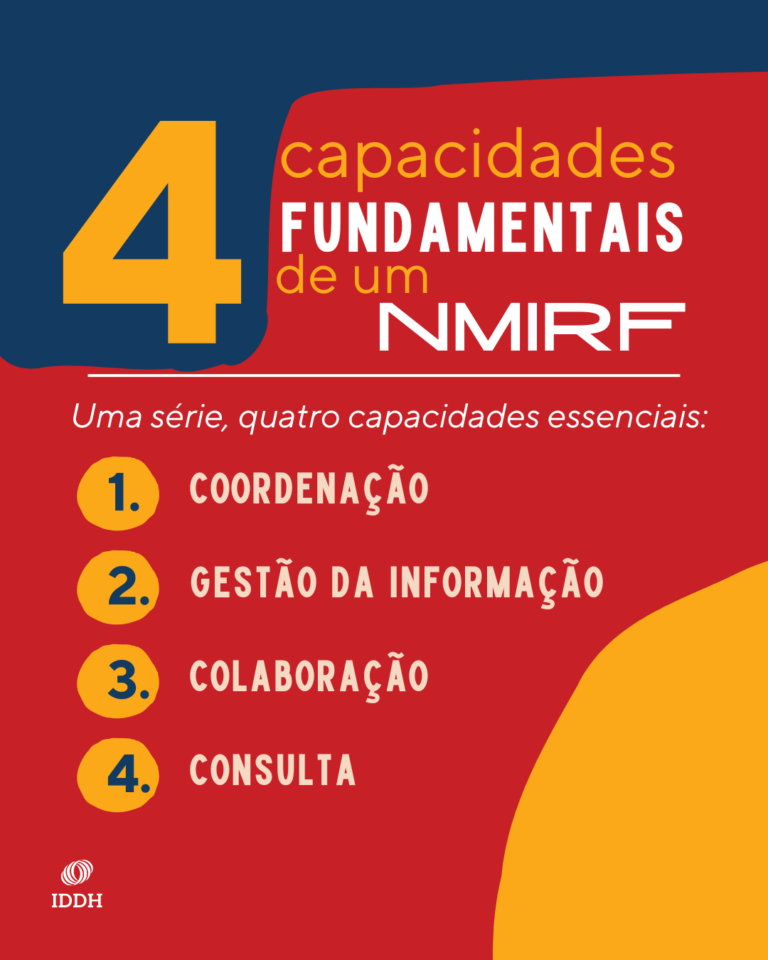
Coordination, information management, collaboration, and consultation are essential capacities for strengthening the implementation and follow-up of international human rights recommendations.

Over the past few weeks, the Institute for Development and Human Rights (IDDH) has presented a series of content exploring the fundamental capacities of a National Mechanism for Implementation, Reporting and Follow-up (NMIRF).

NMIRFs are structures designed to support States in implementing and following up on recommendations received from international and regional human rights mechanisms. They also contribute to reporting processes and to coordination among the different actors involved.

Beyond periodically reporting to international mechanisms, permanent national structures can help ensure that States’ international commitments are incorporated into public policies and translated into concrete action.

Coordination: connecting actors to advance implementation

The capacity for coordination enables the establishment of structured and formalized processes among different public bodies and institutions.

Such coordination facilitates communication between ministries and other actors, contributes to institutional memory, helps define responsibilities, and promotes a more integrated approach to the implementation and follow-up of international recommendations.

Effective coordination is also essential to connect international human rights obligations with different levels and spheres of government, helping ensure that implementation reaches the local level.

Information management: organizing information to turn it into action

Implementing international recommendations requires managing a large volume of information across different issues, responsible institutions, deadlines, and commitments.

The capacity for information management therefore enables NMIRFs to organize, systematize, and track this information in a structured manner.

Databases, monitoring matrices, and other tools can help identify responsibilities, track progress, establish priorities, and inform decision-making.

More than simply storing data, managing information means transforming it into knowledge that can guide public policies and support more effective implementation of international recommendations.

Collaboration: building solutions together

The capacity for collaboration creates opportunities for the exchange of experiences, knowledge, and good practices between the State and international and regional human rights mechanisms.

Continuous dialogue and technical cooperation can help identify challenges, improve strategies, and strengthen the institutional capacities needed to implement recommendations.

At the same time, collaboration must be connected to social participation. Strengthening national mechanisms cannot simply result in new institutional structures: civil society must have the conditions to actively participate in implementation and follow-up processes.

Consultation: meaningful social participation

The capacity for consultation is directly related to creating spaces for dialogue between the State and different sectors of society.

But consultation cannot simply mean listening.

For IDDH, participation must be meaningful, inclusive, continuous, and transparent, ensuring that civil society has the conditions to contribute not only to reporting processes, but also to the follow-up and implementation of recommendations.

The challenge, therefore, goes beyond creating mechanisms or tracking recommendations. It requires building permanent, integrated, transparent, and participatory processes capable of connecting international commitments with public policies and the realities experienced at the local level.

Through this series, IDDH seeks to contribute to a broader discussion on the role of NMIRFs and the importance of national mechanisms capable of transforming international human rights recommendations into concrete action.

Related news

Publications
25/08/2026
The Fundamental Capacities of an NMIRF: From Recommendations to Implementation
Uncategorized
15/05/2026
Launch: UPR - How to Implement Human Rights
Uncategorized
24/02/2026
Spoiler alert: The 2nd edition of our Agenda 2030: Youth in the Territories course is coming soon in a pocket version!

The Fundamental Capacities of an NMIRF: From Recommendations to Implementation

Coordination, information management, collaboration, and consultation are essential capacities for strengthening the implementation and follow-up of international human rights recommendations.

Over the past few weeks, the Institute for Development and Human Rights (IDDH) has presented a series of content exploring the fundamental capacities of a National Mechanism for Implementation, Reporting and Follow-up (NMIRF).

NMIRFs are structures designed to support States in implementing and following up on recommendations received from international and regional human rights mechanisms. They also contribute to reporting processes and to coordination among the different actors involved.

Beyond periodically reporting to international mechanisms, permanent national structures can help ensure that States’ international commitments are incorporated into public policies and translated into concrete action.

Coordination: connecting actors to advance implementation

The capacity for coordination enables the establishment of structured and formalized processes among different public bodies and institutions.

Such coordination facilitates communication between ministries and other actors, contributes to institutional memory, helps define responsibilities, and promotes a more integrated approach to the implementation and follow-up of international recommendations.

Effective coordination is also essential to connect international human rights obligations with different levels and spheres of government, helping ensure that implementation reaches the local level.

Information management: organizing information to turn it into action

Implementing international recommendations requires managing a large volume of information across different issues, responsible institutions, deadlines, and commitments.

The capacity for information management therefore enables NMIRFs to organize, systematize, and track this information in a structured manner.

Databases, monitoring matrices, and other tools can help identify responsibilities, track progress, establish priorities, and inform decision-making.

More than simply storing data, managing information means transforming it into knowledge that can guide public policies and support more effective implementation of international recommendations.

Collaboration: building solutions together

The capacity for collaboration creates opportunities for the exchange of experiences, knowledge, and good practices between the State and international and regional human rights mechanisms.

Continuous dialogue and technical cooperation can help identify challenges, improve strategies, and strengthen the institutional capacities needed to implement recommendations.

At the same time, collaboration must be connected to social participation. Strengthening national mechanisms cannot simply result in new institutional structures: civil society must have the conditions to actively participate in implementation and follow-up processes.

Consultation: meaningful social participation

The capacity for consultation is directly related to creating spaces for dialogue between the State and different sectors of society.

But consultation cannot simply mean listening.

For IDDH, participation must be meaningful, inclusive, continuous, and transparent, ensuring that civil society has the conditions to contribute not only to reporting processes, but also to the follow-up and implementation of recommendations.

The challenge, therefore, goes beyond creating mechanisms or tracking recommendations. It requires building permanent, integrated, transparent, and participatory processes capable of connecting international commitments with public policies and the realities experienced at the local level.

Through this series, IDDH seeks to contribute to a broader discussion on the role of NMIRFs and the importance of national mechanisms capable of transforming international human rights recommendations into concrete action.