
Access to international advocacy mechanisms still seems distant for Indigenous and traditional territories in Brazil, but through human rights education, a seed planted in the form of knowledge becomes a strategy for struggle and survival for these communities.
The workshop “Complaints to national and international bodies,” conducted by defender Mariana Lacerda during the 2026 Mato Grosso State Free Land Camp (Acampamento Terra Livre Estadual do Mato Grosso), brought together Indigenous leaders from the Juruena River Basin and marked the conclusion of an advocacy cycle of the ECOAR project promoted by IDDH.
Mariana is a people’s lawyer and indigenist who has worked for five years with strategic litigation within the Juruena Vivo Network, through the Indigenous rights program of OPAN – Operação Amazônia Nativa, aiming to defend the Juruena River Basin and the population that lives there, in the interior of Mato Grosso.
This ancestral territory is of great importance for the maintenance of Brazilian biodiversity, as it is where the source of the Tapajós River is located and encompasses around 12 Indigenous peoples (including isolated groups), as well as various riverine communities, quilombola communities, and other traditional peoples who live along the banks of the Juruena.
Faced with a reality marked by the advance of mining companies, deforestation, and large hydroelectric projects in the waters of the Juruena—factors that deepen inequalities within these territories—the workshop proposes a pathway for Indigenous communities to access new ways of filing complaints and securing constitutional rights.
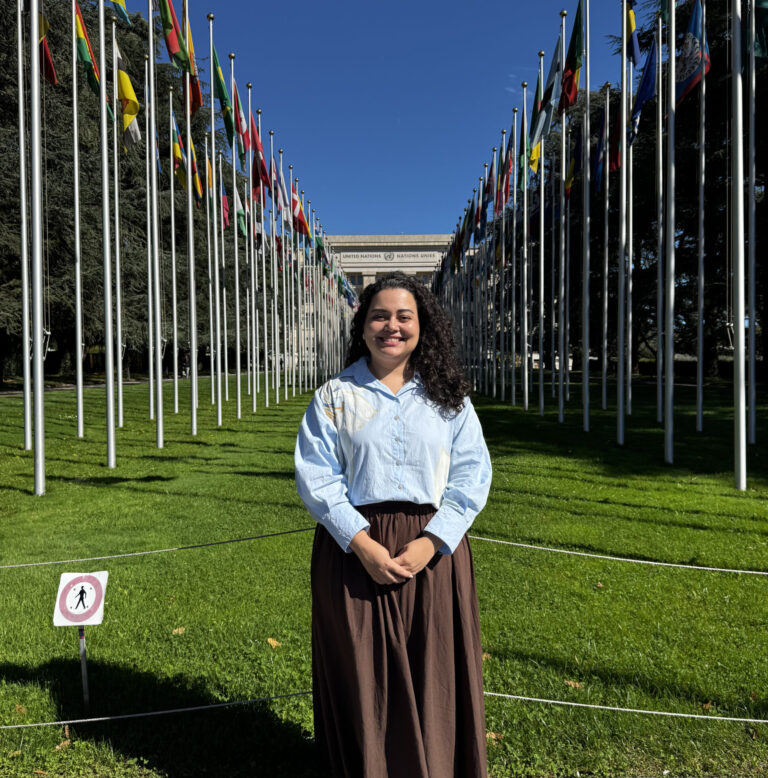
For the defender, drawing from her experience within ECOAR—having accessed UN spaces during the 60th session of the Human Rights Council with IDDH and gaining an inside understanding of how international policies function—allowed her work within the Network to be expanded.
Based on her experience in Geneva, Mariana developed a training adapted to the Indigenous context, where the complexities of the Brazilian and international legal systems were explained and, in a participatory manner, the Network’s leaders were able to connect national and international mechanisms to their realities, understanding how they can and should be activated in confronting serious human rights violations affecting their communities.
For Mariana, ECOAR marked a turning point in how she understands her own role within the Juruena Vivo Network. Having been present at the 60th session of the UN Human Rights Council provided her with tools to translate, in practice, a system that previously seemed accessible only to those who already occupied those spaces.
Her path of advocacy following ECOAR does not end with the workshop held in Cuiabá; rather, it multiplies through each leader who now carries a body of knowledge that previously belonged only to spaces like Geneva.
This ability to make national and international legal frameworks accessible to the everyday realities of villages and communities in the Juruena—and which now complements her work as a people’s lawyer—makes her trajectory an example of how training in international advocacy can be transformed into a direct instrument for territorial defense.